Beasts of Ephesus

Learn. Something.

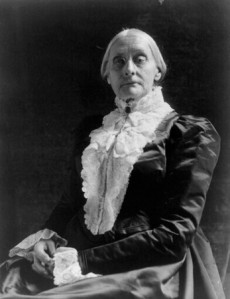
Profile: Susan B. Anthony

Posted by jase on November 12, 2009

susanbanthonySusan Brownell Anthony (February 15, 1820 – March 13, 1906) was a prominent American civil rights leader who played a pivotal role in the 19th century women’s rights movement to introduce women’s suffrage into the United States. She traveled the United States and Europe, and gave 75 to 100 speeches every year on women’s rights for 45 years.

Susan B. Anthony was born and raised in West Grove, near Adams, Massachusetts. She was the second oldest of seven children, Guelma Penn (1818), Susan Brownell (1820), Hannah E. (1821), Daniel Read (1824), Mary Stafford (1827), Eliza Tefft (1832), and Jacob Merritt (1834), born to Daniel Anthony and Lucy Read. One brother, publisher Daniel Read Anthony, would become active in the anti-slavery movement in Kansas, while a sister, Mary Stafford Anthony, became a teacher and a woman’s rights activist. Anthony remained close to her sisters throughout her life.

In 1849, at age 29, Anthony quit teaching and moved to the family farm in Rochester, New York. She began to take part in conventions and gatherings related to the temperance movement. In Rochester, she attended the local Unitarian Church and began to distance herself from the Quakers, in part because she had frequently witnessed instances of hypocritical behavior such as the use of alcohol amongst Quaker preachers. As she got older, Anthony continued to move further away from organized religion in general, and she was later chastised by various Christian religious groups for displaying irreligious tendencies.

In her youth, Anthony was very self-conscious of her looks and speaking abilities. She long resisted public speaking for fear she would not be sufficiently eloquent. Despite these insecurities, she became a renowned public presence, eventually helping to lead the women’s movement.

Early social activism

In the era before the American Civil War, Anthony took a prominent role in the New York anti-slavery and temperance movements. In 1836, at age 16, Susan collected two boxes of petitions opposing slavery, in response to the gag rule prohibiting such petitions in the House of Representatives.  In 1849, at age 29, she became secretary for the Daughters of Temperance, which gave her a forum to speak out against alcohol abuse, and served as the beginning of Anthony’s movement towards the public limelight.

On January 1, 1868, Anthony first published a weekly journal entitled The Revolution. Printed in New York City, its motto was: “The true republic — men, their rights and nothing more; women, their rights and nothing less.” Anthony worked as the publisher and business manager, while Elizabeth Cady Stanton acted as editor. The main thrust of The Revolution was to promote women’s and African-Americans’ right to suffrage, but it also discussed issues of equal pay for equal work, more liberal divorce laws and the church’s position on women’s issues. The journal was backed by independently wealthy George Francis Train, who provided $600 in starting funds.

Though she never married, Anthony published her views about sexuality in marriage, holding that a woman should be allowed to refuse sex with her husband; the American woman had no legal recourse at that time against rape by her husband. Anthony spoke very little on the subject of abortion. Of primary importance to Anthony was the granting to woman the right to her own body which she saw as an essential element for the prevention of unwanted pregnancies, using abstinence as the method. In The Revolution, Anthony wrote in 1869 about the subject, arguing that instead of merely attempting to pass a law against abortion, the root cause must also be addressed. Simply passing an anti-abortion law would, she wrote, “be only mowing off the top of the noxious weed, while the root remains.” Anthony continued: “Guilty? Yes, no matter what the motive, love of ease, or a desire to save from suffering the unborn innocent, the woman is awfully guilty who commits the deed. It will burden her conscience in life, it will burden her soul in death; but oh! thrice guilty is he who, for selfish gratification, heedless of her prayers, indifferent to her fate, drove her to the desperation which impelled her to the crime.”

American Equal Rights Association

In 1869, long-time friends Frederick Douglass and Susan B. Anthony found themselves, for the first time, on opposing sides of a debate. The American Equal Rights Association (AERA), which had originally fought for both blacks’ and women’s right to suffrage, voted to support the 15th Amendment to the Constitution, granting suffrage to black men, but not women. Anthony questioned why women should support this amendment when black men were not continuing to show support for women’s voting rights. Partially as a result of the decision by the AERA, Anthony soon thereafter devoted herself almost exclusively to the agitation for women’s rights.

On November 18, 1872, Anthony was arrested by a U.S. Deputy Marshal for voting illegally in the 1872 Presidential Election two weeks earlier. She had written to Stanton on the night of the election that she had “positively voted the Republican ticket – straight…”. She was tried and convicted seven months later, despite the stirring and eloquent presentation of her arguments that the recently adopted Fourteenth Amendment, which guaranteed to “all persons born or naturalized in the United States” the privileges of citizenship, and which contained no gender qualification, gave women the constitutional right to vote in federal elections. The sentence was a fine, but not imprisonment; and true to her word in court, she never paid the penalty for the rest of her life. The trial gave Anthony the opportunity to spread her arguments to a wider audience than ever before.

National suffrage organizations

In 1869, Anthony and Elizabeth Cady Stanton founded the National Women’s Suffrage Association (NWSA), an organization dedicated to gaining women’s suffrage. Anthony was vice-president-at-large of the NWSA from the date of its organization until 1892, when she became president.

In the early years of the NWSA, Anthony made many attempts to unite women in the labor movement with the suffragist cause, but with little success. She and Stanton were delegates at the 1868 convention of the National Labor Union. However, Anthony inadvertently alienated the labor movement not only because suffrage was seen as a concern for middle-class rather than working-class women, but because she openly encouraged women to achieve economic independence by entering the printing trades, where male workers were on strike at the time. Anthony was later expelled from the National Labor Union over this controversy.
Susan B. Anthony, who died 14 years before passage of the 19th Amendment giving women the right to vote, was honored as the first real (non-allegorical) American woman on circulating U.S. coinage with her appearance on the Susan B. Anthony dollar. The coin, approximately the size of a U.S. quarter, was minted for only four years, 1979, 1980, 1981, and 1999. Anthony dollars were minted for circulation at the Philadelphia and Denver mints for all four years, and at the San Francisco mint for the first three production years.

Posted in Historic Figures, History, Inspiring Stories, Profiles, Women | Tagged: , , , , , | Leave a Comment »

Dog Hair May Provide Insight on Cancer

Posted by jase on August 27, 2009

Scientists have located the genes that make a poodle’s hair curly, and a collie’s hair long and straight.

No, this wasn’t just a way to ease the boredom of laboratory work, but part of a long-term project to figure out how genes cause disease.

The coats of domestic dogs vary widely — they can be long, short, straight, wavy, curly, wiry, smooth or a combination of different varieties. And that difference is exactly why cancer geneticist Elaine Ostrander decided to study dog hair.

Ostrander, who works at the National Human Genome Research Institute, wanted to know how genes create all this variety. So she studied about 1,000 dogs from about 90 different breeds.

She searched dog DNA the way a chef might compare recipes for souffle. What changed ingredient makes one different from the next? What mutation gives an Airedale terrier his curls and a golden retriever her tresses?

A Three-Gene Recipe

What Ostrander and her team discovered was that only three genes control all the different kinds of dog hair.

“You can go to the dog park, and every breed of dog looks different from every other breed, it seems,” says Ostrander. “Yet, you know, when we get down to the molecular biology, we really find that it’s a combination of three different genes that accounts for all that variation.”

This also has value in studying disease. Human and dog cancers are similar, so the fact that only three genes can create so much variation in hair might provide clues to how genes cause so many cancers in dogs and humans.

“Whether or not the exact same gene is mutated in humans doesn’t really matter,” says Ostrander. “It’s telling us the pathways that are involved, the kinds of genes that are involved, and the kinds of changes in those genes that lead to those diseases.”

The research appears online Thursday in Science Express.

Source: NPR

Posted in Animals, Biology, DNA, Science | Tagged: , , , , , | Leave a Comment »

Are People Who Believe in a “Higher Power” Happier?

Posted by jase on August 23, 2009

Researchers accidentally discovered that people with religious beliefs tend to be more content in life while studying an unrelated topic. While not the original objective, the recent European study found that religious people are better able to cope with shocks such as losing a loved one or getting laid off of a job.

Professor Andrew Clark, from the Paris School of Economics, and co-author Dr Orsolya Lelkes, from the European Centre for Social Welfare Policy and Research, analyzed the a variety of factors among Catholic and Protestant Christians and found that life satisfaction seems to be higher among the religious population. The authors concluded that religion in general, might act as a “buffer” that protects people from life’s disappointments.

“We originally started the research to work out why some European countries had more generous unemployment benefits than others, but our analysis suggested that religious people suffered less psychological harm from unemployment than the non-religious,” noted Professor Clark. “They had higher levels of life satisfaction”. Data from thousands of European households revealed higher levels of “life satisfaction” in believers.

Professor Clark suspects that a variety of aspects are at play, and that perhaps a “religious upbringing” could be responsible for the effect, rather than any particular religious beliefs. The researchers say they found that the religious crowd tended to experience more “current day rewards”, rather than storing them up for the future. Previous studies have also found strong correlations between religion and happiness.

The idea that religion may offer substantial psychological benefits in life, is in sharp contrast with another common viewpoint that religion is repressive and has a negative influence on human development. Professor Leslie Francis, from the University of Warwick believes that the benefit might involve the increased “purpose of life” experienced by many believers that may not be as strongly felt among nonbelievers.

“These findings are consistent with other studies which suggest that religion does have a positive effect, although there are other views which say that religion can lead to self-doubt, and failure, and thereby have a negative effect,” said Francis. “The belief that religion damages people is still in the minds of many.” Terry Sanderson, a leading UK secularist, gay rights activist and president of the National Secular Society, said that any study describing a link between happiness and religion is “meaningless”. “Non-believers can’t just turn on a faith in order to be happy. If you find religious claims incredible, then you won’t believe them, whatever the supposed rewards in terms of personal fulfillment,” he said. “Happiness is an elusive concept, anyway – I find listening to classical music blissful and watching football repulsive. Other people feel exactly the opposite. In the end, it comes down to the individual and, to an extent, their genetic predispositions.”

While no one would argue that genetics don’t influence one’s disposition, Justin Thacker, head of Theology for the Evangelical Alliance, says that there are definitely other factors worth considering. He says a belief in God increases one’s feeling that life is meaningful. “There is more than one reason for this – part of it will be the sense of community and the relationships fostered, but that doesn’t account for all of it. A large part of it is due to the meaning, purpose and value which believing in God gives you, whereas not believing in God can leave you without those things.”

Previous studies have concluded that humans are biologically predisposed to believe in God. Historically, most cultures have developed some sort of religious belief that included at least some form of a “higher power”. From an evolutionary and psychological perspective, these questions have intrigued scientists for decades, but the physiological and cognitive study of religion is still relatively young. Both believers and non-believers can agree on the scientific findings, and still interpret it quite differently notes Ian Ramsey Centre for science and religion in the University of Oxford researchers who are currently working on a project to better understand the cognitive science of religion.

“One element of the current project is to develop philosophical and theological treatments of what the findings from cognitive science of religion means for various theological positions,” states the Cognition, Religion and Theology Project outline. “ “One element of the project is scientifically explaining not just belief in gods but why some people become atheists.

If scientists can explain why people tend to believe in gods and also why other people tend to believe there are no gods, then surely the presence of a scientific explanation cannot mean that you should not believe one way or the other just on the presence or possibility of such an explanation. Non-believers might find satisfaction in a sound scientific explanation of why people tend to believe in God because they can now account for why people persist in believing in a fictitious being. The believer might find satisfaction in the scientific documentation of how human nature predisposes people to believe in God because it could reinforce the idea that people were divinely designed to know and believe in God. Both believers and non-believers can agree on the scientific findings.”

Posted by Rebecca Sato.

Source: Daily Galaxy

Posted in Culture, Psychology, Religion | Tagged: , , , , , , , , , | Leave a Comment »

How Fast Can a Human Possibly Run?

Posted by jase on August 16, 2009

Amazing as Usain Bolt’s new world record 100-meter victory was, his time of 9.58 seconds is nowhere near what biostatisticians such as Peter Weyand of SMU thinks is the natural limit for the human body. Experts studying the steady progression of records over the past 50 years, see the limit of the world record, with a probable error of 0.17 seconds, namely, to lie between 9.26 to 9.60 seconds. Some see 5.0 seconds a possibility.

Because 6′ 5″ Usian Bolt broke the mathematical model that had fit 100-meter record data for almost a century, his incredible performance has reset the bar for how fast researchers believe humans ultimately can run. Will it be done by a 6′ 9″  or 7′ future version of Bolt?


How fast will man eventually run? Will he ever run the 100 meters in five seconds flat?

“Not impossible,” says one of the world’s best known authorities on physiology and biomechanics. Professor Peter Weyand, of Southern Methodist University, known for his expertise in terrestrial locomotion and human and animal performance. Weyand said that humans would soon have the ”ability to modify and greatly enhance muscle fibre strength.” This is would actually reduce the difference between the muscle properties of humans and the world’s fastest animal, the cheetah, to almost zero.

Usain Bolt has now brought up the question — will man get faster and faster? And based on what Weyand says, will he one day outrun the cheetah?

“Probably not,” said Weyand. “The same laws of physics apply to all runners. However, biologically speaking, speed is conferred by an ability of the limbs to hit the ground forcefully in relation to the body’s weight, an attribute conferred largely by the properties of the muscles of the runner. The fast four-legged runners or quadrupeds do seem to be advantaged versus bipeds in terms of the mechanics allowed by their anatomy. These mechanics help quadrupeds to get the most out of the muscles that they have in a way that bipedal runners probably cannot.

Scientists believe man can’t run faster than 30 mph, with the best at about 27mph. A cheetah, on the other hand, reaches speeds triple that. Weyand said he expected speed to continue to improve and faster runners to emerge.

Reza Noubary, a mathematician at Bloomsburg University of Pennsylvania and author of a textbook on statistics and sports, had previously calculated an “ultimate record” of 9.44 seconds for the 100 meter.

Mathematicians don’t use the body’s physiology to assess human physical limits. They were merely working with data that suggested that human speed increases were decelerating and would eventually stop completely. Indeed, in some events, like the long jump, the pace of record-setting has slowed nearly to a stop. That record has only been broken twice since 1968.

Despite the success of Mureika’s model, Weyand, said that mathematical models could never predict how fast humans might eventually run.

“Predicting it is fine for the sake of kicks, but it’s not a scientifically valid approach,” Weyand said. “You have to assume that everything that has happened in the past will continue in the future.”

He suggested that it’s impossible for mathematicians to predict the magnitude of the “freakiness of athletic talent at the extreme margins of humanity. Bolt, it turns out, is a perfect example.”

Weyand, who has conducted research on the body types of the top 45 100-meter sprinters in the last 15 years, said that almost all elite runners conform to the body norms for their race length, except for the most-recent Olympic champion.

“Bolt is an outlier. He’s enormous,” Weyand said. “Typically when you get someone that big, they can’t start.”

That’s because muscle speed in animals is generally tied to their size. For example, rodents, being much smaller than elephants, can move their muscles much faster. The same holds true for human beings. Sprinters are short and have more fast-twitch muscle fibers, allowing them to accelerate quickly, but compromising their ability to run longer distances. Four hundred-meter runners, almost always taller, have the reverse composition of muscle fibers.

Bolt, though, combines the mechanical advantages of taller men’s bodies with the fast-twitch fibers of smaller men.

“We don’t really know what the best form is and maybe Bolt is redefining that and showing us we missed something,” said biomechanicist John Hutchinson of the Royal Veterinary College at the University of London, who studies how animals move.

Hutchinson also agreed with Weyand that the human speed limit will remain impossible to predict with any confidence.

For him, it’s the International Olympic Committee and other regulatory authorities that will determine how fast athletes will be able to run by limiting the amount of advanced biotechnologies sprinters can use.

“The limits will be largely set by the rules of the IOC,” Hutchinson said. “It’s kind of an arms race with the regulators of the sport and the people trying to push the technology to the limits. At some point here there must be a détente where technology can’t push us any further and the rules will restrict it.”

With techniques for gene therapy likely to become available at some point in the not-too-distant future, Weyand said that its use by athletes was “inevitable.”

“You could see really freakish things and we probably will,” he warned.

Source: Daily Galaxy

Posted in Biology, DNA, Healthy Living, Medical, Men, Science | Tagged: , , | Leave a Comment »

Get to Know: Outsider Art

Posted by jase on July 27, 2009

The term outsider art was coined by art critic Roger Cardinal in 1972 as an English synonym for art brut (French: [aʁ bʁyt], “raw art” or “rough art”), a label created by French artist Jean Dubuffet to describe art created outside the boundaries of official culture; Dubuffet focused particularly on art by insane-asylum inmates.

While Dubuffet’s term is quite specific, the English term “outsider art” is often applied more broadly, to include certain self-taught or Naïve art makers who were never institutionalized. Typically, those labeled as outsider artists have little or no contact with the mainstream art world or art institutions. In many cases, their work is discovered only after their deaths. Often, outsider art illustrates extreme mental states, unconventional ideas, or elaborate fantasy worlds.

Outsider art has emerged as a successful art marketing category (an annual Outsider Art Fair has taken place in New York since 1992). The term is sometimes misapplied as a catch-all marketing label for art created by people outside the mainstream “art world,” regardless of their circumstances or the content of their work.

In 1991, the first and only such organization dedicated to the study, exhibition and promotion of outsider art was formed in Chicago: Intuit: The Center for Intuitive and Outsider Art. Chicago is often recognized for its concentration of self taught and outsider artists, among them — Henry Darger, Joseph Yoakum, Lee Godie, William Dawson, David Philpot, and Wesley Willis. Intuit maintains a non-profit museum, open to the public, which features exhibitions of art by intuitive, outsider, and self taught artists.

The term outsider art was coined by art critic Roger Cardinal in 1972 as an English synonym for art brut (French: [aʁ bʁyt], “raw art” or “rough art”), a label created by French artist Jean Dubuffet to describe art created outside the boundaries of official culture; Dubuffet focused particularly on art by insane-asylum inmates.

While Dubuffet’s term is quite specific, the English term “outsider art” is often applied more broadly, to include certain self-taught or Naïve art makers who were never institutionalized. Typically, those labeled as outsider artists have little or no contact with the mainstream art world or art institutions. In many cases, their work is discovered only after their deaths. Often, outsider art illustrates extreme mental states, unconventional ideas, or elaborate fantasy worlds.

Outsider art has emerged as a successful art marketing category (an annual Outsider Art Fair has taken place in New York since 1992). The term is sometimes misapplied as a catch-all marketing label for art created by people outside the mainstream “art world,” regardless of their circumstances or the content of their work.

In 1991, the first and only such organization dedicated to the study, exhibition and promotion of outsider art was formed in Chicago: Intuit: The Center for Intuitive and Outsider Art. Chicago is often recognized for its concentration of self taught and outsider artists, among them — Henry Darger, Joseph Yoakum, Lee Godie, William Dawson, David Philpot, and Wesley Willis. Intuit maintains a non-profit museum, open to the public, which features exhibitions of art by intuitive, outsider, and self taught artists.

Jean Dubuffet and art brut

French artist Jean Dubuffet was particularly struck by Bildnerei der Geisteskranken and began his own collection of such art, which he called art brut or raw art. In 1948 he formed the Compagnie de l’Art Brut along with other artists, including André Breton. The collection he established became known as the Collection de l’Art Brut. It contains thousands of works and is now permanently housed in Lausanne, Switzerland.

Dubuffet characterized art brut as:

“Those works created from solitude and from pure and authentic creative impulses – where the worries of competition, acclaim and social promotion do not interfere – are, because of these very facts, more precious than the productions of professionals. After a certain familiarity with these flourishings of an exalted feverishness, lived so fully and so intensely by their authors, we cannot avoid the feeling that in relation to these works, cultural art in its entirety appears to be the game of a futile society, a fallacious parade.” – Jean Dubuffet. Place à l’incivisme (Make way for Incivism). Art and Text no.27 (December 1987 – February 1988). p.36 Dubuffet’s writing on art brut was the subject of a noted program at the Art Club of Chicago in the early 1950s.

Dubuffet argued that ‘culture’, that is mainstream culture, managed to assimilate every new development in art, and by doing so took away whatever power it might have had. The result was to asphyxiate genuine expression. Art brut was his solution to this problem – only art brut was immune to the influences of culture, immune to being absorbed and assimilated, because the artists themselves were not willing or able to be assimilated.

Cultural Context

The interest in “outsider” practices among twentieth century artists and critics can be seen as part of a larger emphasis on the rejection of established values within the modernist art milieu. The early part of the 20th Century gave rise to cubism and the Dada, Constructivist and Futurist movements in art, all of which involved a dramatic movement away from cultural forms of the past. Dadaist Marcel Duchamp, for example, abandoned “painterly” technique to allow chance operations a role in determining the form of his works, or simply to re-contextualize existing “readymade” objects as art. Mid-century artists, including Pablo Picasso, looked “outside” the traditions of high culture for inspiration, drawing from the artifacts of “primitive” societies, the unschooled artwork of children, and vulgar advertising graphics. Dubuffet’s championing of the art brut — of the insane and others at the margins of society—is yet another example of avant-garde art challenging established cultural values.

Terminology

A number of terms are used to describe art that is loosely understood as “outside” of official culture. Definitions of these terms vary, and there are areas of overlap between them. The editors of Raw Vision, a leading journal in the field, suggest that “Whatever views we have about the value of controversy itself, it is important to sustain creative discussion by way of an agreed vocabulary”. Consequently they lament the use of “outsider artist” to refer to almost any untrained artist. “It is not enough to be untrained, clumsy or naïve. Outsider Art is virtually synonymous with Art Brut in both spirit and meaning, to that rarity of art produced by those who do not know its name.”

  • Art Brut: literally translated from French means “raw art”; ‘Raw’ in that it has not been through the ‘cooking’ process: the art world of art schools, galleries, museums. Originally art by psychotic individuals who existed almost completely outside culture and society. Strictly speaking it refers only to the Collection de l’Art Brut.
  • Folk art: Folk art originally suggested crafts and decorative skills associated with peasant communities in Europe – though presumably it could equally apply to any indigenous culture. It has broadened to include any product of practical craftsmanship and decorative skill – everything from chain-saw animals to hub-cap buildings. A key distinction between folk and outsider art is that folk art typically embodies traditional forms and social values, where outsider art stands in some marginal relationship to society’s mainstream.
  • Intuitive art / Visionary art: Raw Vision Magazine’s preferred general terms for outsider art. It describes them as deliberate umbrella terms. However, Visionary Art unlike other definitions here can often refer to the subject matter of the works, which includes images of a spiritual or religious nature. Intuitive art is probably the most general term available. Intuit: The Center for Intuitive and Outsider Art based in Chicago operates a museum dedicated to the study and exhibition of intuitive and outsider art. The American Visionary Art Museum in Baltimore, Maryland is dedicated to the collection and display of visionary art.
  • Marginal art/Art singulier: Essentially the same as Neue Invention; refers to artists on the margins of the art world.
  • Naïve art: Another term commonly applied to untrained artists who aspire to “normal” artistic status, i.e. they have a much more conscious interaction with the mainstream art world than do outsider artists.
  • Neuve Invention: Used to describe artists who, although marginal, have some interaction with mainstream culture. They may be doing art part-time for instance. The expression was coined by Dubuffet too; strictly speaking it refers only to a special part of the Collection de l’Art Brut.
  • Visionary environments: Buildings and sculpture parks built by visionary artists – range from decorated houses, to large areas incorporating a large number of individual sculptures with a tightly associated theme. Examples include Watts Towers by Simon Rodia, Buddha Park and Sala Keoku by Bunleua Sulilat, and The Palais Ideal by Ferdinand Cheval.

Notable outsider artists

  • Nek Chand (b. 1924) is an Indian artist, famous for building the Rock Garden of Chandigarh, a forty acre (160,000 m2) sculpture garden in the city of Chandigarh, India.
  • Ferdinand Cheval (1836–1924) was a country postman in Hauterives, south of Lyon, France. Motivated by a dream, he spent 33 years constructing the Palais Ideal. Half organic building, half massive sculpture, it was constructed from stones collected on his postal round, held together with chicken wire, cement, and lime.
  • Henry Darger (1892–1973) was a solitary man who was orphaned and institutionalised as a child. In the privacy of his Chicago apartment, he produced 15,000 pages of text and hundreds of large scale illustrations, including maps, collaged photos and watercolors that depict his child heroes “the Vivian Girls” in the midst of battle scenes that combine imagery of the US Civil War with fanciful monsters.[1] – link to Henry Darger Room study collection
  • Francis E. Dec (1926–1996) was a U.S. lawyer disbarred in 1961 after what he claimed was a conspiracy and who spent the next thirty years of his life in isolation mailing increasingly paranoid rants to the media. His outlandish worldview and unique writing style made his rants become cult items circulated as involuntary humour and underground poetry.
  • Howard Finster (1916–2001), a self-taught artist, was a preacher from Summerville, Georgia who claimed to be inspired by God to spread the gospel through the built environment of Paradise Garden, his masterpiece, and over 46,000 pieces of art.
  • Madge Gill (1882–1961), was an English mediumistic artist who made thousands of drawings “guided” by a spirit she called “Myrninerest” (my inner rest).
  • Paul Gosch (1885–1940), a schizophrenic German artist and architect murdered by the Nazis in their euthanasia campaign.
  • Alexander Lobanov (1924–2003) was a deaf and autistically withdrawn Russian known for detailed and self-aggrandizing self-portraits: paintings, photographs and quilts, which usually include images of large guns.
  • Helen Martins (1897–1976) transformed the house she inherited from her parents in Nieu-Bethesda, South Africa, into a fantastical environment decorated with crushed glass and cement sculptures. The house is known as The Owl House.
  • Tarcisio Merati (1934–1995), an Italian artist, was confined to a psychiatric hospital for most of his adult life during which time he produced a vast amount of drawings (several dream toys, bird on nest etc) , text and musical composition.
  • Martin Ramirez (1895–1963), a Mexican outsider artist who spent most of his adult life institutionalized in a California mental hospital (he had been diagnosed as paranoid schizophrenic). He developed an elaborate iconography featuring repeating shapes mixed with images of trains and Mexican folk figures.
  • Achilles Rizzoli (1896–1981) was employed as an architectural draftsman. He lived with his mother near San Francisco, California. After his death, a huge collection of elaborate drawings were discovered, many in the form of maps and architectural renderings that described a highly personal fantasy exposition, including portraits of his mother as a neo-baroque building.
  • Judith Scott (1943–2005) was born deaf and with Down Syndrome. After taking a fiber art class at an art institute for the disabled, she began to produce objects wrapped in many layers of string and fibers.
  • Bunleua Sulilat (1932–1996) was a Thai/Lao myth-maker and informal religious leader who organized large groups of unskilled volunteers for the construction of two religious-themed parks featuring giant fantastic concrete sculptures.
  • Miroslav Tichý (b. 1926) wandered the small Moravian town of Kyjov in rags, pursuing his obsession with the female form by secretly photographing women in the streets, shops and parks with cameras he made from tin cans, children’s spectacle lenses and other junk he found on the street. He would return home each day to make prints on equally primitive equipment, making only one print from the negatives he selected. His work remained largely unknown until 2005, when he was 79 years old.
  • Adolf Wölfli (1864–1930), a Swiss artist, was confined to a psychiatric hospital for most of his adult life during which time he produced a vast amount of drawings, text and musical composition. Wölfli was the first well-known “outsider artist,” and he remains closely associated with the label.
  • Kiyoshi Yamashita (1922–1971) was a Japanese graphic artist who spent much of his life wandering as a vagabond through Japan. He has been considered an autistic savant.
  • Scotti Wilson (1928–1972) (born Louis Freeman), emigrated from Scotland to the United States and opened a second-hand clothes store, found fame when his casual doodlings were noted for their dream-like character.
  • Bill Traylor (1854–1949). Better characterized as “self-taught” than “outsider,” Traylor was born into slavery in Alabama. Unable to read or write, he first began drawing in 1939 at the age of eighty-three. He worked full-time for the next four years to produce over eighteen hundred drawings. He used a straight edge to create geometric silhouettes of human and animal figures which he then filled in with crayon and tempera. He is known for his intriguing use of pattern versus flat color and a remarkably intuitive sense of space.

Posted in Art, Artists, Culture, Society | Tagged: , , , , , , , , | 2 Comments »

Leap Year – In Other Countries

Posted by jase on July 27, 2009

The Gregorian calendar, used by most western countries, recognizes an extra day at the end of February every four years except centenary years not divisible by 400. However, some cultures use calendars that do not apply the same leap year rules as the Gregorian calendar.

Some calendars, such as the Iranian calendar, do not observe February 29 as a leap day. Other calendars, such as the Chinese calendar, recognize a leap month. A few calendars that do not follow the conventional leap year model are listed below.  

Chinese Leap Year

The Chinese leap year has 13 months. A leap month is added to the Chinese calendar about every three years. The name of a leap month is the same as previous lunar month. The leap month’s place in the Chinese calendar varies from year to year. Unlike the Gregorian calendar, 2006 was a leap year in the Chinese calendar.

To determine a leap year, calculate the number of new moons between the 11th month in one year and the 11th month in the following year. A leap month is inserted if there are 13 moons from the start of the 11th month in the first year to the start of the 11th month in the next year. The leap month does not contain a principal term (Zhongqi). The Chinese calendar has been used for centuries and observes the movement of the sun, moon and stars. 

Jewish Leap Year

Like the Chinese calendar, the Jewish calendar has 13 months in a leap year. There are 29 or 30 days in each month in a Jewish leap year, which has 383, 384, or 385 days. An extra month, Adar I, is added after the month of Shevat and before the month of Adar in a leap year. According to Jewish tradition, Adar is a lucky and happy month.

A leap year is referred to in Hebrew as Shanah Me’uberet, or a pregnant year. A Jewish leap year occurs seven times in a 19-year cycle. The 3rd, 6th, 8th, 11th, 14th, 17th, and 19th years are leap years in this cycle.  

Iranian Leap Year

There are about eight leap years in every 33-year cycle in the Iranian (or Persian) calendar. An extra day is added to the last month in a leap year. Leaps years occur when there are 366 days between two New Year’s days. However, it is not universally accepted that the calendar is solely based on observing the vernal equinox.

Leap years usually occur every four years. After every six or seven leap years, the Iranian calendar provides for a leap year that occurs on the fifth year instead of the fourth year. A period of 2820 years was the base for calculations to establish the frequency of a leap year occurring on the fifth year. At the start and the end of the 2820-year cycle, the vernal equinox takes place exactly at the same time of the tropical year.  

The Iranian calendar dates back to the 11th century, when a panel of scientists created a calendar that was more accurate than other calendars at the time. Although some changes have been made to the calendar, it is slightly more accurate than the Gregorian calendar. Compared with the Gregorian calendar, which errors by one day in about every 3226 years, the Iranian calendar needs a one-day correction in about every 141,000 years.  

Hindu Leap Year

The Hindu calendar inserts an extra month, often referred to as Adhika Maas, in a leap year. Adhika Maas typically occurs once every three years or four times in 11 years. Therefore the yearly lag of a lunar year is adjusted every three years. This adjustment allows for Hindu festivals tend to occur within a given span rather than on a set day.

The Indian National Calendar and the Revised Bangla Calendar of Bangladesh organize their leap years so their leap day is close to February 29 in the Gregorian calendar.  

Islamic Leap Year

In the Islamic Hijri calendar one extra day is added to the last month (making it 30 days instead of 29 days) in a leap year. This month, Dhu ‘l-Hidjdja, is also referred to as the month of the Hajj – the Muslim pilgrimage to Mecca. The Hijri calendar has a 30-year cycle with 11 leap years of 355 days and 19 years of 354 days. In the long term, it is accurate to about one day in 2500 years.

The leap year occurs in the 2nd, 5th, 7th, 10th, 13th, 16th, 18th, 21st, 24th, 26th and 29th years of the 30-year cycle. Leap months are forbidden by the Qur’an. The calendar is based on the Qur’an and its proper observance is a sacred duty for Muslims. It is a purely lunar calendar and contains 12 months that are based on the moon’s motion.  

Bahá’í Leap Year

The Bahá’í year begins on March 21 and is divided into 19 months of 19 days each, totaling 361 days. Four or five intercalary days are added to raise the number of days to 365, or 366 in leap years. The leap day is inserted in the days of Ayyam-i-ha , a period of intercalary days devoted to fasting preparations, hospitality, charity and gift-giving from February 26 to March 1.

Ethiopian Leap Year

The Ethiopian calendar is very similar to the Egyptian Coptic calendar, which has 13 months. Like the Coptic calendar, the Ethiopian calendar adds an extra day to the end of the year once every four years. The Ethiopian and Coptic calendars consist of 13 months, where the first 12 months each have 30 days and the 13th month has six days in a leap year instead of five days in a standard year.

Other Leap Years

Greece converted to the Gregorian calendar in 1924, although there is debate that the change may have occurred in 1920 or as early as 1916. There is discussion that some Orthodox Christians prefer to use a revised Julian calendar, where there is a discrepancy with the Gregorian calendar with regard to a leap year that will occur in 2800.

More information

Further reading

Source: TimeAndDate.com

Posted in Countries, Solar Energy, Time | Tagged: , , , , , , , , , | Leave a Comment »

Profile: Mexico City

Posted by jase on July 26, 2009

Mexico City (Spanish: Ciudad de México, D.F. (for Distrito Federal), México or Méjico is the capital city of Mexico. It is the economic, industrial, and cultural center in the country, and the most populous city, with about 8,836,045 inhabitants in 2008. Greater Mexico City (Zona Metropolitana del Valle de México) incorporates 59 adjacent municipalities of Mexico State and 29 municipalities of the state of Hidalgo, according to the most recent definition agreed upon by the federal and state governments. Greater Mexico City has a population exceeding 19 million people, making it the second largest metropolitan area in the western hemisphere and the third largest in the world by population according to the United Nations. In 2005, it ranked the eighth in terms of GDP (PPP) among urban agglomerations in the world. Mexico City is a major global city in Latin America and ranked 25th among global cities by Foreign Policy’s 2008 Global Cities Index.

Mexico City is also the Federal District (Distrito Federal). The Federal District is coterminous with Mexico City; both are governed by a single institution and are constitutionally considered to be the same entity. This has not always been the case. The Federal District, created in 1824, was integrated by several municipalities, one of which was the municipality of Mexico City. As the city began to grow, it engulfed all other municipalities into one large urban area. In 1928, all municipalities within the Federal District were abolished, an action that left a vacuum in the legal status of Mexico City vis-à-vis the Federal District, even though for most practical purposes they were traditionally considered to be the same entity. In 1993, to end the sterile discussions about whether one concept had engulfed the other, or if any of the two entities had any existence in lieu of the other, the 44th Article of the Constitution of Mexico was reformed to clearly state that Mexico City is the Federal District, seat of the Powers of the Union and capital of the United Mexican States.

According to a study conducted by PricewaterhouseCoopers, Greater Mexico City, with a population of 19.2 million, had a GDP of $315 billion in 2005 at purchasing power parity, an urban agglomeration with the eighth highest GDP in the world after the greater areas of Tokyo, New York, Los Angeles, Chicago, Paris, London and Osaka/Kobe, and the highest in Latin America. In 2020, it is expected to rank seventh with a $608 billion GDP, displacing Osaka/Kobe.

As of 2008, the city had a GDP of about $221 billion, with an income per capita of $25,258, well above the national average and on par with high income economies such as South Korea or the Czech Republic.

Mexico City is located in the Valley of Mexico, also called the Valley of Anáhuac, a large valley in the high plateaus at the center of Mexico, at an altitude of 2,240 meters (7,349 ft). The city was originally built as Tenochtitlan by the Aztecs in 1325 on an island of Lake Texcoco. It was almost completely destroyed in the siege of 1521, and was subsequently redesigned and rebuilt in accordance with the Spanish urban standards. In 1524 the municipality of Mexico City was established, known as México Tenustitlán, and as of 1585 it is officially known as ciudad de México.

History

Spanish conquest of Tenochtitlán

After landing in Veracruz, Hernán Cortés heard about the great city and the long-standing rivalries and grievances against it. Although Cortés came to Mexico with a very small army, he was able to persuade many of the other native peoples to help him destroy Tenochtitlán.

Cortés first saw Tenochtitlán on 8 November 1519. Upon viewing it for the first time, Cortés and his men were stunned by its beauty and size. The Spaniards marched along the causeway leading into the city from Iztapalapa. Although Montezuma came out from the center of Tenochtitlán to greet them and exchange gifts, the camaraderie did not last long. Cortés put Montezuma under house arrest, hoping to rule through him. Tensions increased until, on the night of June 30, 1520 – during a struggle commonly known as “La Noche Triste” – the Aztec revolted against the Spanish intrusion and managed to capture or drive out the Europeans and their Tlaxcalan allies. Cortés regrouped at Tlaxcala. The Aztecs thought the Spaniards were permanently gone. They elected a new king, Cuauhtémoc. Cortés decided to lay siege to Tenochtitlán in May 1521. For three months, the city suffered from the lack of food and water as well as the spread of smallpox brought by the Europeans. Cortés and his allies landed their forces in the south of the island and fought their way through the city, street by street, and house by house. Finally, Cuauhtémoc had to surrender in August 1521.

The Spaniards practically razed Tenochtitlán. Cortés first settled in Coyoacan, but decided to rebuild the Aztec site in order to erase all traces of the old order. Cortés did not establish an independent, conquered territory under his own personal rule, but remained loyal to the Spanish crown. The first viceroy of the new domain arrived in Mexico City fourteen years later. By that time, the city had again become a city-state, having power that extended far beyond the city’s established borders. Although the Spanish preserved Tenochtitlán’s basic layout, they built Catholic churches over the old Aztec temples and claimed the imperial palaces for themselves. Tenochtitlán was renamed “Mixico”, its alternative form name, as the Spanish found this easier to say.

20th Century and Beyond

The history of the rest of the 20th century to the present focuses on the phenomenal growth of the city and its environmental and political consequences. In 1900, the population of Mexico City was about 500,000. The city began to grow rapidly westward in the early part of the 20th century. and then began to grow upwards in the 1950s, with the Torre Latinoamericana as the first skyscraper. The 1968 Olympic Games brought about the construction of large sporting facilities. In 1969, the Metro system was inaugurated. Explosive growth in the population of the city started from the 1960s, with the population overflowing the boundaries of the Federal District into the neighboring state of Mexico, especially to the north, northwest and northeast. Between 1960 and 1980 the city’s population more than doubled to 8,831,079. 1980 – half of all the industrial jobs in Mexico were located in Mexico City. Under relentless growth, the Mexico City government could barely keep up with services. Villagers from the countryside who continued to pour into the city to escape poverty only compounded the city’s problems. With no housing available, they took over lands surrounding the city, creating huge shantytowns that extended for many miles. This caused serious air and water pollution problems, as well as a sinking city due to overextraction of groundwater. Air and water pollution has been contained and improved in some several areas due to government programs, the renovation of vehicles and the modernization of the public transport.

The autocratic government that ruled Mexico City since the Revolution was tolerated, mostly because of the continued economic expansion since World War II. This was the case even though this government could not handle the population and pollution problems adequately. Nevertheless, discontent and protests began in the 1960s leading to the massacre of an unknown number of protesting students in Tlatelolco.

However, the last straw may have been the 1985 Mexico City earthquake. On Thursday, 19 September 1985, at 7:19 am local time, Mexico City was struck by an earthquake of magnitude 8.1 on the Richter scale. While this earthquake was not as deadly or destructive as many similar events in Asia and other parts of Latin America it proved to be a disaster politically for the one-party government. The government was paralyzed by its own bureaucracy and corruption, forcing ordinary citizens to not only create and direct their own rescue efforts but efforts to reconstruct much of the housing that was lost as well. This discontent eventually led to Cuauhtémoc Cárdenas, a member of the Party of the Democratic Revolution, becoming the first elected mayor of Mexico City in 1997. Cárdenas promised a more democratic government, and his party claimed some victories against crime, pollution, and other major problems. He resigned in 1999 to run for the presidency.

Geography & Climate

Mexico City is located in the Valley of Mexico, sometimes called the Basin of Mexico. This valley is located in the Trans-Mexican Volcanic Belt located in the high plateaus of central Mexico.  

Mexico City has a temperate highland climate (Koppen Cwb), due to its tropical location and high elevation. The lower region of the valley receives less rainfall than the upper regions of the south; the lower boroughs of Iztapalapa, Iztacalco, Venustiano Carranza and the west portion of Gustavo A. Madero are usually drier and warmer than the upper southern boroughs of Tlalpan and Milpa Alta, a mountainous region of pine and oak trees known as the range of Ajusco.

The average annual temperature varies from 12 to 16°C (53 to 60°F), depending on the altitude of the borough. Lowest temperatures, usually registered during January and February, may reach -2 to -5°C (28 to 23°F), usually accompanied by snow showers on the southern regions of Ajusco, and the maximum temperatures of late spring and summer may reach up to 32°C (92°F). Overall precipitation is heavily concentrated in the summer months, including dense hail. The central valley of Mexico rarely gets precipitation in the form of snow during winter; the two last recorded instances of such an event were on March 5, 1940 and January 12, 1967.

The region of the Valley of Mexico receives anti-cyclonic systems, whose weak winds do not allow for the dispersion, outside the basin, of the air pollutants which are produced by the 50,000 industries and 4 million vehicles operating in or around the metropolitan area.

The area receives about 700 millimeters of annual rainfall, which is concentrated from June through September/October with little or no precipitation the remainder of the year. The area has two main seasons. The rainy season runs from June to October when winds bring in tropical moisture from the sea. The dry season runs from November to May, when the air is relatively drier. This dry season subdivides into a cold period from November to February when polar air masses pushing down from the north keep the air fairly dry and a warm period from March to May when tropical winds again dominate but they do not yet carry enough moisture for rain.

Demographics

Historically, and since pre-Hispanic times, the valley of Anáhuac has been one of the most densely populated areas in Mexico. When the Federal District was created in 1824, the urban area of Mexico City extended approximately to the area of today’s Cuauhtémoc borough. At the beginning of the twentieth century, the elites began migrating to the south and west and soon the small towns of Mixcoac and San Ángel were incorporated by the growing conurbation. According to the 1921 census, 30.79% of the population was White, 54.78% was Mestizo, 11.74% was Indigenous and 2.69% other races (mostly Mulattoes, Blacks and some Cantonese Chinese Immigrants) . Today the city could be clearly divided into a middle and high-class area (south and west, including Polanco, Chapultepec and Santa Fe), and a lower class area to the east (Ciudad Nezahualcóyotl, Pantitlán, Chalco and Moctezuma).

Up to the 1980s, the Federal District was the most populated federal entity in Mexico, but since then its population has remained stable at around 8.7 million. The growth of the city has extended beyond the limits of the Federal District to 59 municipalities of the state of Mexico and 1 in the state of Hidalgo. With a population of approximately 19.8 million inhabitants (2008), it is one of the most populated conurbations in the world. Nonetheless, the annual rate of growth of the Metropolitan Area of Mexico City is much lower than that of other large urban agglomerations in Mexico, a phenomenon most likely attributable to the environmental policy of decentralization. The net migration rate of the Federal District from 1995 to 2000 was negative.

While they represent around 1.3% of the city’s population, indigenous peoples from different regions of Mexico have immigrated to the capital in search of better economic opportunities. Náhuatl, Otomí, Mixteco, Zapoteco, and Mazahua are the indigenous languages with the greatest number of speakers in Mexico City.

On the other hand, Mexico City is home to large communities of expatriates, most notably from South America (mainly from Argentina, but also from Chile, Uruguay, Colombia, Brazil and Venezuela), from Europe (mainly from Spain and Germany, but also from France, Italy, Turkey, Poland and Romania), the Middle East (mainly from Lebanon and Syria), and recently from Asia (mainly from China and South Korea). While no official figures have been reported, population estimates of each of these communities are quite significant. Mexico City is home to the largest population of U.S. Americans living outside the United States. Some estimates are as high as 600,000 U.S. Americans living in Mexico City, while in 1999 the U.S. Bureau of Consular Affairs estimates over 440,000 Americans lived in the Mexico City Metropolitan Area.

The majority (90.5%) of the residents in Mexico City are Roman Catholic, higher than the national percentage, even though it has been decreasing over the last decades. However, many other religions and philosophies are also practiced in the city: many different types of Protestant groups, different types of Jewish communities, Buddhist and other philosophical groups, as well as atheism.

  • 1950 – 3 million people lived in Mexico City.
  • 1975 – 12 million people lived in Mexico City.
  • 2000 – 22 million people lived in Mexico City.

Nicknames

Mexico City was traditionally known as La Ciudad de los Palacios (“the City of the Palaces”), a nickname attributed to Baron Alexander von Humboldt when visiting the city in the 19th century who sending a letter back to Europe said Mexico city could rival any major city in Europe.

During López Obrador’s administration a political slogan was introduced: la Ciudad de la Esperanza (“The City of Hope”). This slogan was quickly adopted as a nickname to the city under López Obrador’s term, although it has lost popularity since the new slogan Capital en Movimiento (“Capital in Movement”) was adopted by the recently elected administration headed by Marcelo Ebrard Casaubon; the latter is not treated as a nickname in media.

The city is colloquially known as Chilangolandia after the locals’ nickname chilangos, which is used either as a pejorative term by people living outside Mexico City or as a proud adjective by Mexico City’s dwellers.

Residents of Mexico City are more formally called capitalinos (in reference to the city being the capital of the country) or, more recently defeños (a word which derives from the postal abbreviation of the Federal District in Spanish: D.F., which is read “De-Efe”.)

Posted in Countries, Culture, Globalization, Mexico, Profiles, Society, Urbanism | Tagged: , , , , , , , , , | Leave a Comment »

Profile: Diego Rivera

Posted by jase on July 26, 2009

Diego Rivera (December 8, 1886 – November 24, 1957) was born Diego María de la Concepción Juan Nepomuceno Estanislao de la Rivera y Barrientos Acosta y Rodríguez in Guanajuato, Gto. He was a world-famous Mexican painter, an active Communist, and husband of Frida Kahlo, 1929-1939 and 1940-1954 (her death). Rivera’s large wall works in fresco helped establish the Mexican Mural Renaissance. Between 1922 and 1953, Rivera painted murals in Mexico City, Chapingo, Cuernavaca, San Francisco, Detroit, and New York City. His 1931 retrospective exhibition at the Museum of Modern Art in New York City was their second.

Early life

Diego Rivera was born in Guanajuato City, Guanajuato, to a well-off family. Rivera was descended, on his mother’s side, from Jews who converted to Roman Catholicism, and, on his father’s side, from Spanish nobility. Since he was ten years of age, Rivera studied art at the Academy of San Carlos in Mexico City. He was sponsored to continue study in Europe by Teodoro A. Dehesa Méndez, the governor of the State of Veracruz.

After arrival in Europe in 1907, Rivera initially went to study with Eduardo Chicharro in Madrid, Spain, and from there went to Paris, France, to live and work with the great gathering of artists in Montparnasse, especially at La Ruche, where his friend Amedeo Modigliani painted his portrait in 1914. His circle of close friends, which included Ilya Ehrenburg, Chaim Soutine, Modigliani’s wife Jeanne Hébuterne, Max Jacob, gallery owner Leopold Zborowski, and Moise Kisling, was captured for posterity by Marie Vorobieff-Stebelska (Marevna) in her painting “Homage to Friends from Montparnasse” (1962).

In those years, Paris was witnessing the beginning of cubism in paintings by such eminent painters as Pablo Picasso and Georges Braque. From 1913 to 1917, Rivera enthusiastically embraced this new school of art. Around 1917, inspired by Paul Cézanne’s paintings, Rivera shifted toward Post-Impressionism with simple forms and large patches of vivid colors. His paintings began to attract attention, and he was able to display them at several exhibitions.

Career in Mexico

In 1920, urged by Alberto J. Pani, the Mexican ambassador to France, Rivera left France and traveled through Italy studying its art, including Renaissance frescoes. After Jose Vasconcelos became Minister of Education, Rivera returned to Mexico in 1921 to become involved in the government sponsored Mexican mural program planned by Vasconcelos. (See also Mexican Muralism)The program included such Mexican artists as José Clemente Orozco, David Alfaro Siqueiros, and Rufino Tamayo, and the French artist Jean Charlot. In January 1922, he painted – experimentally in encaustic – his first significant mural Creation in the Bolívar Auditorium of the National Preparatory School in Mexico City guarding himself with a pistol against right-wing students.

In the autumn of 1922, Rivera participated in the founding of the Revolutionary Union of Technical Workers, Painters and Sculptors, and later that year he joined the Mexican Communist Party (including its Central Committee). His murals, subsequently painted in fresco only, dealt with Mexican society and reflected the country’s 1910 Revolution. Rivera developed his own native style based on large, simplified figures and bold colors with an Aztec influence clearly present in murals at the Secretariat of Public Education in Mexico City begun in September 1922, intended to consist of one hundred and twenty-four frescoes, and finished in 1928.

His art, in a fashion similar to the steles of the Maya, tells stories. The mural “En el Arsenal” (In the Arsenal) shows on the right hand side Tina Modotti holding an ammunition belt and facing Julio Antonio Mella, in a light hat, and Vittorio Vidale behind in a black hat. Rivera’s radical political beliefs, his attacks on the church and clergy, as well as his dealings with Trotskyists and left-wing assassins made him a controversial figure even in communist circles. Leon Trotsky even lived with Rivera and Kahlo for several months while exiled in Mexico. Some of Rivera’s most famous murals are featured at the National School of Agriculture at Chapingo near Texcoco (1925–27), in the Cortés Palace in Cuernavaca (1929-30), and the National Palace in Mexico City (1929–30, 1935).

Work Abroad

In the autumn of 1927, Rivera arrived in Moscow, accepting an invitation to take part in the celebration of the 10th anniversary of the October Revolution. Subsequently, he was to paint a mural for the Red Army Club in Moscow, but in 1928 he was ordered out by the authorities because of involvement in anti-Soviet politics, and he returned to Mexico. In 1929, Rivera was expelled from the Mexican Communist Party. His 1928 mural In the Arsenal was interpreted by some as evidence of Rivera’s prior knowledge of the murder of Julio Antonio Mella allegedly by Stalinist assassin Vittorio Vidale. After divorcing Guadalupe (Lupe) Marin, Rivera married Frida Kahlo in August 1929. Also in 1929, the first English-language book on Rivera, American journalist Ernestine Evans’s The Frescoes of Diego Rivera, was published in New York. In December, Rivera accepted a commission to paint murals in the Palace of Cortez in Cuernavaca from the American Ambassador to Mexico.

In September 1930, Rivera accepted an invitation from architect Timothy L. Pflueger to paint for him in San Francisco, California. After arriving in November accompanied by Kahlo, Rivera painted a mural for the City Club of the San Francisco Stock Exchange for US$2,500 and a fresco for the California School of Fine Art, which is now in the San Francisco Art Institute. Kahlo and Rivera worked and lived at the studio of Ralph Stackpole, who had suggested Rivera to Pflueger. Rivera met Helen Wills Moody, a famous tennis player, who modeled for his City Club mural. In November 1931, Rivera had a retrospective exhibition at the Museum of Modern Art in New York City. Kahlo was present at the opening of the New York MoMA show. Between 1932 and 1933, he completed a famous series of twenty-seven fresco panels entitled Detroit Industry on the walls of an inner court at the Detroit Institute of Arts. During the McCarthyism of the 1950s, a large sign was placed in the courtyard defending the artistic merit of the murals while attacking his politics as “detestable.”

His mural Man at the Crossroads, begun in 1933 for the Rockefeller Center in New York City, was removed after a furor erupted in the press over a portrait of Vladimir Lenin it contained. As a result of the negative publicity, a further commission was cancelled to paint a mural for an exhibition at the Chicago World’s Fair. In December 1933, Rivera returned to Mexico, and he repainted Man at the Crossroads in 1934 in the Palacio de Bellas Artes in Mexico City. This surviving version was called Man, Controller of the Universe. On June 5, 1940, invited again by Pflueger, Rivera returned for the last time to the United States to paint a ten-panel mural for the Golden Gate International Exposition in San Francisco. Pan American Unity was completed November 29, 1940. As he was painting, Rivera was on display in front of Exposition attendees. He received US$1,000 per month and US$1,000 for travel expenses. The mural includes representations of two of Pflueger’s architectural works as well as portraits of Kahlo, woodcarver Dudley C. Carter, and actress Paulette Goddard, who is depicted holding Rivera’s hand as they plant a white tree together. Rivera’s assistants on the mural included the pioneer African-American artist, dancer, and textile designer Thelma Johnson Streat. The mural and its archives reside at City College of San Francisco.

Personal Life

Rivera was a notorious womanizer who had fathered at least one illegitimate child. Angelina Beloff was his first wife and gave birth to a son, Diego (1916-1918). Maria Vorobieff-Stebelska gave birth to a daughter in 1918 or 1919 when Rivera was married to Angelina.(According to “House on the Bridge: Ten Turbulent Years with Diego Rivera” and Angeline’s memoirs called “Memorias”. He married his second wife, Guadalupe Marín, in June 1922, with whom he had two daughters. He was still married when he met the art student Frida Kahlo. They married on August 21, 1929 when he was forty-two and she was twenty-two. Their mutual infidelities and his violent temper led to divorce in 1939, but they remarried December 8, 1940 in San Francisco. After Kahlo’s death, Rivera married Emma Hurtado, his agent since 1946, on July 29, 1955. He died on November 24, 1957.

Posted in Art, Artists, Historic Figures, Men, Mexico, Profiles | Tagged: , , , , , , , | 1 Comment »

7 of History’s Most Infamous Curses

Posted by jase on July 25, 2009

1. James Dean and “Little Bastard”

On September 30, 1955, James Dean was killed when the silver Porsche 550 Spyder he called “Little Bastard” was struck by an oncoming vehicle. Within a year or so of Dean’s crash, the car was involved in two more fatal accidents and caused injury to at least six other people. After the accident, the car was purchased by hot-rod designer George Barris.

While getting a tune up, Little Bastard fell on the mechanic’s legs and crushed them. Barris later sold the engine and transmission to two doctors who raced cars. While racing against each other, one driver was killed, the other seriously injured. Someone else had purchased the tires, which blew simultaneously, sending the driver to the hospital.

Little Bastard was set to appear in a car show, but a fire broke out in the building the night before the show, destroying every car except Little Bastard, which survived without so much as a smudge. The car was then loaded onto a truck to go back to Salinas, California. The driver lost control en route, was thrown from the cab, and was crushed by the car when it fell off the trailer. In 1960, after being exhibited by the California Highway Patrol, Little Bastard disappeared and hasn’t been seen since.

2. The Curse of Tutankhamen’s Tomb

In 1922, English explorer Howard Carter, leading an expedition funded by George Herbert, Fifth Earl of Carnarvon, discovered the ancient Egyptian king’s tomb and the riches inside. After opening the tomb, however, strange and unpleasant events began to take place in the lives of those involved in the expedition.

Lord Carnarvon’s story is the most bizarre. The adventurer apparently died from pneumonia and blood poisoning following complications from a mosquito bite. Allegedly, at the exact moment Carnarvon passed away in Cairo, all the lights in the
city mysteriously went out. Carnarvon’s dog dropped dead that morning, too. Some point to the foreboding inscription, “Death comes on wings to he who enters the tomb of a pharaoh” as proof that King Tut put a curse on anyone who disturbed his final resting place.

3. “The Club”

If you’re a rock star and you’re about to turn 27, you might want to consider taking a year off to avoid membership in “The Club.” Robert Johnson, an African-American musician, who Eric Clapton called “the most important blues musician who ever lived,” played the guitar so well that some said he must have made a deal with the devil. So when he died at 27, folks said it must have been time to pay up.

Since Johnson, a host of musical geniuses have gone to an early grave at age 27. Brian Jones, founding member of the Rolling Stones, died at age 27 in 1969. Then it was both Jimi Hendrix and Janis Joplin in 1970 and Jim Morrison the following year. Kurt Cobain joined “The Club” in 1994. All 27 years old. Coincidence? Or were these musical geniuses paying debts, too?

4. “Da Billy Goat” Curse

In 1945, William “Billy Goat” Sianis brought his pet goat, Murphy, to Wrigley Field to see the fourth game of the 1945 World Series between the Chicago Cubs and the Detroit Tigers. Sianis and his goat were later ejected from the game, and Sianis reportedly put a curse on the team that day. Ever since, the Cubs have had legendarily bad luck.

Over the years, Cubs fans have experienced agony in repeated late-season collapses when victory seemed imminent. In 1969, 1984, 1989, and 2003, the Cubs were painfully close to advancing to the World Series but couldn’t hold the lead. Even those who don’t consider themselves Cubs fans blame the hex for the weird and almost comical losses year after year. The Cubs have not won a World Series since 1908 — no other team in the history of the game has gone as long without a championship.

5. Rasputin and the Romanovs

Rasputin, the self-proclaimed magician and cult leader, wormed his way into the palace of the Romanovs, Russia’s ruling family, around the turn of the last century. After getting a little too big for his britches, a few of the Romanovs allegedly decided to have him killed. But he was exceptionally resilient.

Reportedly it took poison, falling down a staircase, and repeated gunshots before Rasputin was finally dead. It’s said that Rasputin mumbled a curse from his deathbed, assuring Russia’s ruling monarchs that they would all be dead within a year. That did come to pass, as the Romanov family was brutally murdered in a mass execution less than a year later.

6. Tecumseh and the American Presidents

The curse of Tippecanoe, or “Tecumseh’s Curse,” is a widely held explanation of the fact that from 1840 to 1960, every U.S. president elected (or reelected) every twentieth year has died in office. Popular belief is that Tecumseh administered the curse when William Henry Harrison’s troops defeated the Native American leader and his forces at the Battle of Tippecanoe. Check it out:

  • William Henry Harrison was elected president in 1840. He caught a cold during his inauguration, which quickly turned into pneumonia. He died April 4, 1841, after only one month in office.
  • Abraham Lincoln was elected president in 1860 and reelected four years later. Lincoln was assassinated and died April 15, 1865.
  • James Garfield was elected president in 1880. Charles Guiteau shot him in July 1881. Garfield died several months later, from complications following the gunshot wound.
  • William McKinley was elected president in 1896 and reelected in 1900. On September 6, 1901, McKinley was shot by Leon F. Czolgosz, who considered the president an “enemy of the people.” McKinley died eight days later.
  • Three years after Warren G. Harding was elected president in 1920, he died suddenly of either a heart attack or stroke while traveling in San Francisco.
  • Franklin D. Roosevelt was elected president in 1932 and reelected in 1936, 1940, and 1944. His health wasn’t great, but he died rather suddenly in 1945, of a cerebral hemorrhage or stroke.
  • John F. Kennedy was elected president in 1960 and assassinated in Dallas three years later.
  • Ronald Reagan was elected president in 1980, and though he was shot by an assassin in 1981, he did survive. Some say this broke the curse, which should make George W. Bush happy. At the time of this writing, Bush, who was elected in 2000, is serving his second term in office.

7. The Curse of the Kennedy Family

Okay, so maybe if this family had stayed out of politics and off airplanes, their fate might be different. Regardless, the number of Kennedy family tragedies have led some to believe there must be a curse on the whole bunch. You decide:

  • JFK’s brother Joseph, Jr., and sister Kathleen both died in separate plane crashes in 1944 and 1948, respectively.
  • JFK’s other sister, Rosemary, was institutionalized in a mental hospital for years.
  • John F. Kennedy himself, America’s 35th president, was assassinated in 1963 at age 46.
  • Robert Kennedy, JFK’s younger brother, was assassinated in 1968.
  • Senator Ted Kennedy, JFK’s youngest brother, survived a plane crash in 1964. In 1969, he was driving a car that went off a bridge, causing the death of his companion, Mary Jo Kopechne. His presidential goals were pretty much squashed after that.
  • In 1984, Robert Kennedy’s son David died of a drug overdose. Another son, Michael, died in a skiing accident in 1997.
  • In 1999, JFK, Jr., his wife, and his sister-in-law died when the small plane he was piloting crashed into the Atlantic Ocean.

Source: How Stuff Works

Posted in Culture, Curses, Historic Events, Historic Figures, History, Native American, Society | Tagged: , , , , , , | Leave a Comment »

10 Years Away From Artificial Human Brain?

Posted by jase on July 25, 2009

“It’s a new brain. The mammals needed it because they had to cope with parenthood, social interactions, complex cognitive functions. It was so successful an evolution from mouse to man it expanded about a thousand fold in terms of the numbers of units to produce this almost frightening organ. It is evolving at an enormous speed.”

Henry Markram, Director, Project Blue Brain. 

Excellent news for fans of computer technology, neuroscience, and people who think that humans telling the machines what to do is totally backwards.  Henry Markram, director of the Blue Brain Project, says we are ten years away from a functional artificial human brain. The Blue Brain project was launched in 2005 and aims to reverse engineer the mammalian brain from laboratory data.

We reported on the attempts of the Swiss Mind Brain Institute to simulate the neocortical column of the rat last year using an IBM Blue Gene machine with 10,000 processors, and they’ve announced success of the first phase of their project.

“We cannot keep on doing animal experiments forever,” Markram told the audience at the TED Global Conference at Oxford, England. “There are two billion people on the planet affected by mental disorder,” he told the audience. The project may give insights into new treatments.”

They’ve successfully simulated the neocortical column of a rat – only a fraction of a full brain, but they proved that you don’t get to do world-shattering research when you settle for second-best by choosing one of the most complicated and vital pieces of any mammalian cortex.

They also proved that even world-class scientists still have to compete for funding, following up this amazing achievement with bold claims that the same process could simulate an entire rat brain within three years, and a human brain within ten.  Obviously a team that sat down one day and said “We’re going to build a mind from scratch using better parts than nature did” is ambitious, but projecting an upgrade to human consciousness  from a 2 mm chunk of grey matter designed purely to think “eat garbage” and “carry Plague” within ten years?  That’s enough to make Alexander the Great wave his hands and say “Hang on guys, aren’t you setting your sights a little high?”

To anyone who’s worked in science the reasons for these assertions are obvious: attention and funding.  And it’s a travesty that they have to do so – they’ve achieved one of the most incredible advances in the last decade of neuroscience and the idea that they have to make that sound even cooler is insane: it’s like inventing a perpetual motion machine and having to offer it in designer colours to get people interested.  Assuming they continue to get support for this little “One of the Greatest Achievements ever to be conceived of by Man” project, it will raise a number of critical questions:

1.  Are we going to need a court order to reboot this thing?

Considering that most scientists don’t subscribe to the “magic invisible soul dust” theory of what creates human consciousness, a simulation that recreates the activity of a human brain may produce ethical concerns.  Technically a computer that recreates a rat brain would raise similar issues but, as you’re about to see, these guys don’t have any sympathy for rats.

2.  How do they plan to get a human model?

The existing rat neocortical model is based on a huge amount of data from real working rat brains – or at least, brains that were working until the scientists got a hold of them.  Where the team ran into gaps in the existing data they cracked open rat skulls, extracted the brains, sliced them into wafers while keeping them alive and recorded their responses.  It isn’t known whether they cackled maniacally while screaming “They said we were fools, but we’ll show them, we’ll show them ALL!” during this procedure, because  anybody who can slice a brain into strips while keeping it alive isn’t someone you want to annoy with questions.

Suffice to say when one third of your research staff are on the “Knifing things in the head” payroll:

a) You’re already two steps into a horror movie script
b) You aren’t just assuming there are no such thing as ghosts, you’re betting the survival of everyone in the building on the fact
c) This is NOT a method that can be scaled up to humans without a rogue agent with nothing to lose being sent to kill you in a highly ironic manner.

3.  Can we make improvements?

Those involved in the project sing its praises in work to understand the human brain, but it’s only a matter of time until somebody thinks about making improvements – minus an hour at most, actually, because that’s the first thing I thought of when I read about it. 

With the ability to simulate the effects of rewiring, drugs or external electric fields at an individual neuron level we can investigate enhancements (such as new senses, new cognitive modes or neuroelectric interfaces) without all the inconvenient “human rights violations” and “Crimes against humanity” such research normally entails.  We could improve our own minds – and since we’ll have just invented a silicon model operating at computer speeds in a bulletproof shell, we’ll have to.

Source: Daily Galaxy

Posted in Biology, Science | Tagged: , , , | Leave a Comment »